
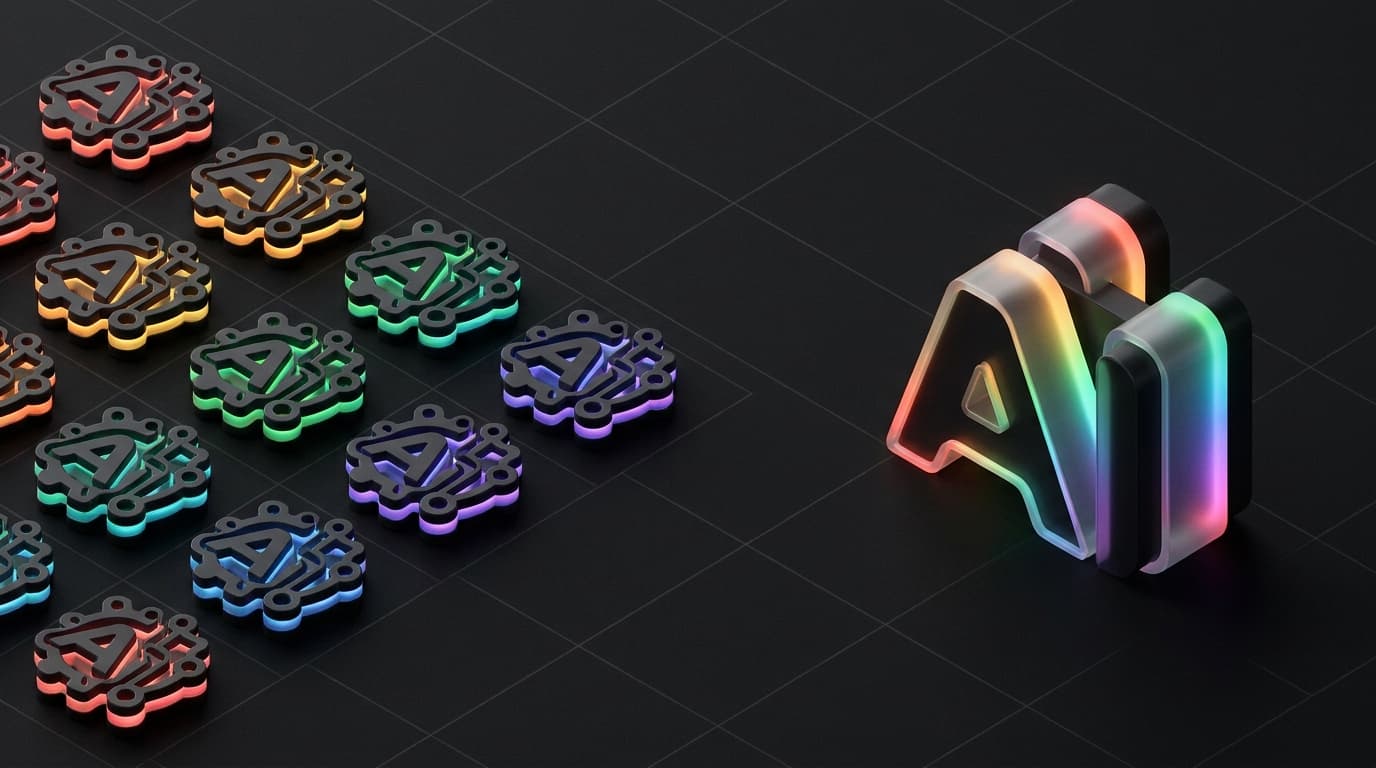
AI branding makes good visuals easy. That is exactly why you stand out less
AI branding has become the fastest way to get clean brand visuals, and that is precisely why your brand stands out less than it did a year ago. The barrier to making something that looks good is gone. Since 8 June 2026, any US customer in the Amazon app can turn a single text prompt into their own custom design on a t-shirt or bottle. Shopify bakes AI product photos straight into the admin: type "in a sunny park, professional ad photography" and you have a scene. What used to take a shoot or a designer is now a button.
That sounds like good news, and for speed it is. But there is a flip side that most founders only see once it is too late: when everyone presses the same button, the same output comes out. AI branding without direction of your own does not make you distinctive. It makes you interchangeable.
The core of this article: a brand is a system, not a template. AI executes that system, but it does not invent it. A tool is only as good as the brand system you feed it. Feed it nothing and you get back the average of everyone else. In six years of building brands for e-commerce, we saw that gap every week. Below we explain why AI branding all looks alike, what a brand system actually is, and how to use AI without landing in the grey middle.
Why does AI branding all look the same?
AI copies your input, not your taste. That is the entire explanation. A language or image model returns what is most likely based on what you put in. Feed it a generic prompt and you get a generic average back, because that is statistically the safest bet. A thousand founders who type "modern, clean, minimalist e-commerce brand" therefore get almost the same result.
You can already see the effect on Bol.com, Amazon and in Shopify stores. The same pastel colors. The same floating products on a soft gradient. The same slightly-too-perfect lighting. It is not ugly. It is worse than ugly: it is forgettable. A buyer scrolls past because nothing makes them stop.
This is not an AI problem. It is a direction problem. The model does exactly what you ask. If your ask is empty, the answer is empty. I build AI systems for my own agency, and the question I keep asking is not "can AI make this", but "how good is the output when I do not give it enough context". The answer is always the same: average. And average does not sell in a category full of lookalikes.
The founders who see AI branding work do not use it to decide what their brand looks like. They use it to execute a brand they already have sharp, faster. That is a fundamentally different starting point, and it explains why two companies with the same tool get such different results.
A brand is a system, not a template
A brand is not your logo and not your color. A brand is how people remember you, and whether they recognize you a second time. A brand system is the set of rules that makes that recognizable: your positioning, your story, your visual language, your typography, your tone, and the way those things return together on every place your brand shows up.
The difference between a brand and a template is the difference between a system and a picture. A template is a single design that is right once. A system is a series of choices that carries through consistently across a hundred places: on your product listing, your packaging, your ad, your customer email and your homepage. We wrote earlier about why branding is more than a logo, and why brand identity ties directly to revenue. The through-line there is the same as here: the look is the shell, the system is the core.
Why this matters for AI: a system is exactly what you can feed a model. A template you can only copy. If your brand is a set of clear rules, AI can apply those rules to ten new visuals without the brand falling apart. If your brand is only a nice picture, AI produces ten variants that shoot off in every direction. The system is the through-line that holds the output together.
This is why a brand system becomes more valuable in the AI era, not less. Execution gets cheap. Direction gets scarce. Whoever has a sharp system can use cheap execution without losing recognizability. Whoever has no system gets cheap execution that looks exactly like the neighbor's.
AI tool versus brand system: which does what?
The question is never "AI or human". The question is which layer of the work belongs to which. AI is strong at the executing, repeating work you need in large numbers. The brand system, and the human who guards it, sits on the originating part: the choice of what you are and why someone remembers you.
| Work | AI tool | Brand system (human) |
|---|---|---|
| Positioning and meaning | no | yes |
| Inventing the creative concept | no | yes |
| Setting recognition rules | no | yes |
| Making ten image variants | yes | directs |
| Generating backgrounds and scenes | yes | directs |
| Listing copy at volume | yes | directs |
| Testing and iterating A/B variants | yes | directs |
| Overseeing consistency across channels | partly | yes |
Read the table as a division of labor, not a fight. Everything in the right column is input for everything in the left column. The brand system decides what the tool may make, the tool makes it fast and in large numbers. Reverse the order, and let the tool decide what the brand is, and you get back the average we described above.
This is exactly the distinction we make with CGI and AI product visualization: you choose the technique per situation, you never choose the brand per tool. Picking a render or an AI image is an execution choice within the system. The choice of what your brand means sits above it and does not change because a new button arrived.
The tool is only as good as the context you feed it
I believe AI always needs to be directed with a creative idea. The executing creative work AI can do in 2026. The originating work it cannot. The difference between usable and forgettable AI output is almost always the context that came before it.
A concrete example from our work. When we made visuals for Screenmate, it did not start with a prompt. It started with the question of which emotion the product had to evoke, in which situation a buyer pictured it, and which visual codes fit that. Only then came execution, where fast iteration can run through a tool just fine. Without that first layer, every variant would have been technically correct and brandless. With that layer, every variant read as the same brand, no matter how many we made.
That is the role of a brand system as a context source. You do not feed the tool one loose instruction, you feed it your positioning, your color and shape language, your tone and your recognition rules. Then the output becomes an extension of the brand instead of a guess. The same holds for text: we wrote earlier about why undirected AI content costs you rankings. The cause is identical. Without input of your own, the model produces the most average answer, and average disappears.
The founders who get the most out of this treat their brand system as the most expensive asset they own. Not the logo, not the webshop, but the set of choices that makes AI produce something of theirs instead of something of no one's.
Product images: white in slot one, AI lifestyle after
For your visuals it means you let AI do the work it is good at, and you let humans do the work where the brand is at stake. Native tools now cover the "good enough" background for free. Shopify documents where that feature stops itself: the output comes at one megapixel resolution in the admin, you can make one AI scene at a time, and there is an invisible watermark on every image. Handy for a quick test. Not where your hero shot comes from.
Where AI still structurally falls short in 2026: correct product scale, physical grounding (does the product actually sit on that table or float), tactile detail where a buyer wants to feel the material, and campaign consistency across multiple images. Our own rule of thumb after hundreds of shoots and renders: photography stays stronger for organic material and real human interaction, while AI and CGI win once you have many variants or many SKUs.
For building a strong product catalog, a simple split works in practice. The main image wins with a sharp shot on white, because that is what the marketplace expects and what stays legible on a small thumbnail. From the second image on, lifestyle and context win, which you can speed up with AI as long as your art direction matches your brand. Analyses of product imagery on the PDP show the same pattern: white converts as the main image, lifestyle wins in the gallery and in ads. One catalog that works on the marketplace and on your own Shopify is a brand choice, not a tool choice.
Where AI branding does strengthen your brand
The picture above is not an argument against AI. Used from a sharp system, AI speeds up exactly the things a small team otherwise gets stuck on. You can test ten variants of a lifestyle scene in an afternoon instead of scheduling one shoot. You can roll out a listing in five languages without the tone falling away, provided you set that tone first. You can build seasonal campaigns without starting from zero every time.
The pattern is always the same: AI magnifies what is already there. Have a strong brand system, and AI magnifies your recognizability across more channels and more visuals than you would reach by hand. Have no system, and AI magnifies your lack of direction just as hard. The tool is neutral. What you put in decides whether scale works for you or against you.
That is also why we see AI as a reason to invest in a brand system earlier, not later. You used to get by for a while on loose, reasonable visuals. Now that execution becomes free and fast, the advantage shifts to whoever has the sharpest direction. The brand is the one part that cannot be copied with a prompt.
What you can do tomorrow
The trap is starting at the tool. You open Shopify Magic or an AI image generator, type a prompt, and hope a brand rolls out. It does not. Start at the system, and the tool becomes valuable. Three concrete steps:
First, put your positioning into one sentence that can only be yours. Not "quality products for the modern consumer", because anyone can paste that. Instead the specific promise your buyer recognizes and the competitor cannot copy. This is the first layer you feed a tool.
Next, put your visual rules on paper: your colors, your shape language, your typography, your photo style, and the recognition elements that return on every image. This is not a forty-page brandbook. It is the set of rules that makes a buyer know after three images that it is yours. Without this layer, AI has nothing to hold on to.
Only then let AI execute, within those rules. Generate variants, test backgrounds, make several versions quickly, and use the human to guard that every output follows the system. That gets you the speed of AI and the recognizability of a brand. It is the order we have to explain at almost every first conversation: first the brand, then the button.
How Oase looks at this
We are not anti-AI. We build AI systems ourselves, Milo runs our operation and we use AI daily for execution. We are also not dogmatically pro-shoot. We know when a shoot wins and when AI wins, and we have both in house. That is the difference, not which tool we pick.
What we saw over and over in six years and more than two hundred reviews: a brand does not survive poor positioning, however good the visuals are. And a strong brand system survives every new tool, because it decides what that tool may make. When I ran my own e-commerce brand at 23, I learned that the shell is the easy part. The question of what a brand actually means to a buyer, that is the work.
If your brand still looks like yours in the AI era, it is not because you picked the best tool. It is because you had a system to feed that tool. Do you think your brand is disappearing into the grey middle, or do you want to know what a brand system looks like that makes AI work in your favor? See how we approach it, or read first why a listing starts with the brand and not the tactic.
