
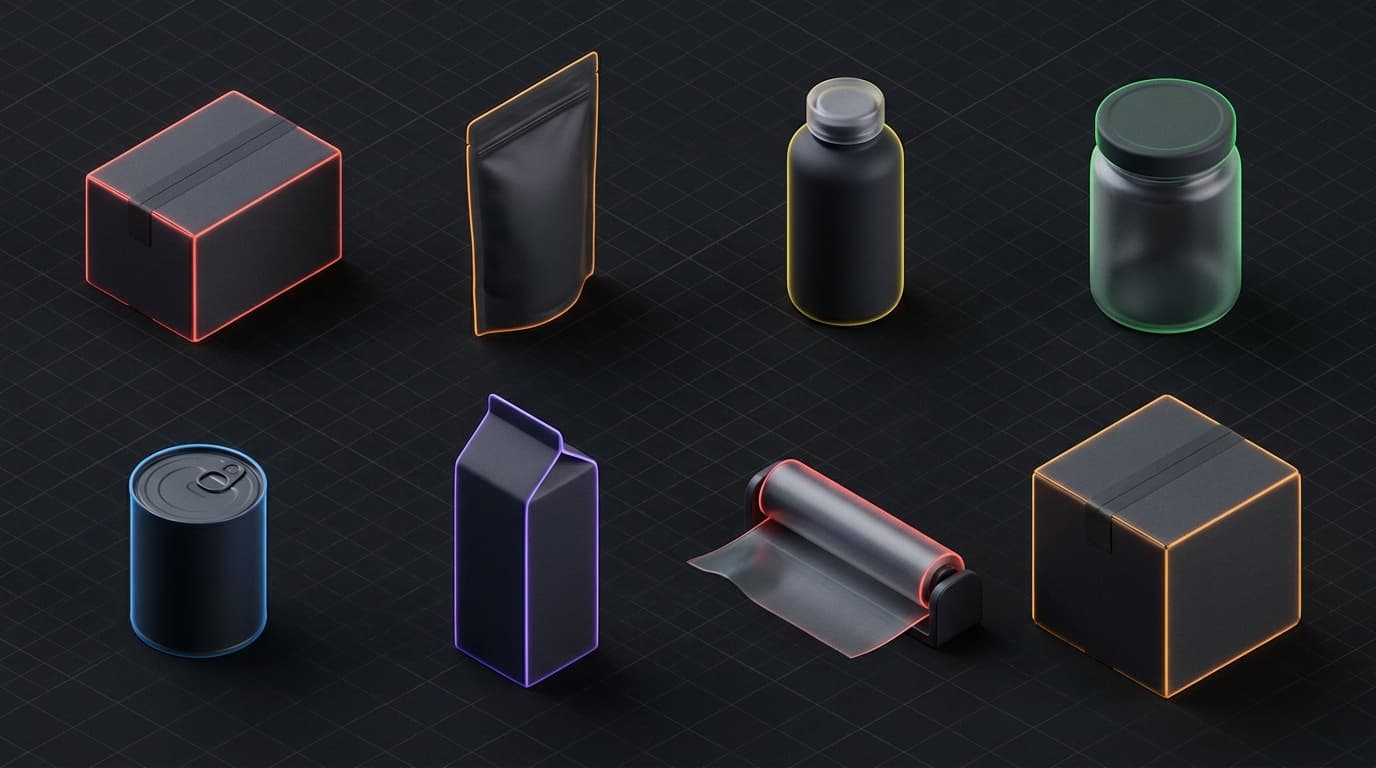
There is no single PPWR checklist: each packaging type tells a different story
On 12 August 2026 three things become materially hard under EU Regulation 2025/40: the Declaration of Conformity per packaging type (Article 39), the PFAS ban for food contact (Article 5) and the minimisation principle (Article 10). The big hits circulating in the Dutch press, recycled-content percentages and the 50% cap on void space, only arrive later: 1 January 2030 for Article 7 and Article 24, with escalation in 2040. Anyone panicking now about a 50% box portfolio for August is probably buying too early. What actually counts in August 2026: PFAS tests, supplier documentation, and one DoC per cardboard format instead of per SKU.
This article works through eight packaging types, with the exact 12 August requirement, the later deadlines and the concrete action for a seller per type. A broader explanation of PPWR is in PPWR 2026: what changes for your e-commerce packaging. The 12 general fix-it points are in PPWR checklist 2026: 12 points before 12 August. This page goes one layer deeper.
Where does the Dutch reporting on PPWR go wrong?
The claim doing the rounds: "from 12 August 2026 an e-commerce package may contain at most 50% void space". That rule is a blend of two separate articles.
Article 10 of Regulation 2025/40 (the minimisation principle) takes effect on 12 August 2026. It states that packaging must be "as much as needed, no more" for function, safety and protection. No fixed percentage. No formula. But enforceable: a shipping box that carries 80% air can already be challenged by the regulator in 2026 as not necessary.
Article 24 (the void-space cap) only takes effect on 1 January 2030. Only from that moment does the hard formula apply: void-space ratio is box volume minus product volume, divided by box volume, times 100. At most 50% for e-commerce, grouped and transport packaging. And filler material counts as void space. So you cannot "compensate" by topping up, you have to make your box smaller.
The difference between Article 10 and Article 24 is not a detail. It decides whether you have to buy new box sizes now or whether you have until 2028 to rationalise your portfolio. The regulation itself (EU 2025/40 via EUR-Lex) and the European Commission overview of packaging waste confirm that Article 24 carries a 2030 deadline. Sellers who keep these two deadlines apart make the right investment at the right time.
Cardboard: which grades really need to be in order now?
Cardboard is the largest portfolio component for most e-commerce sellers. Shipping boxes, product boxes, filler, labels and sleeves all fall under the same set of rules, but the impact varies by use.
From 12 August 2026, for every type of cardboard placed on the market:
- Declaration of Conformity (Article 39 and Annex VIII) per cardboard type, with technical documentation under Annex VII Module A
- Retention obligation: 5 years for single-use, 10 years for reusable
- PFAS ban (Article 5) for cardboard in food contact, three-tier threshold
- Minimisation principle (Article 10) on grammage and box volume
Later deadlines to factor into your procurement now:
- 12 August 2028: harmonised label (Article 12) with material pictogram, sorting instruction and QR data carrier
- 1 January 2030: recyclability grade A, B or C required under Article 6. Grade D and E banned
- 1 January 2038: only grade A or B permitted
For cardboard, grade A is usually achievable because paper-recycling infrastructure is mature. The risk sits in coatings and non-paper components: PE films on grease-resistant paper, plastic windows in folding cartons, or metallic laminates. Those now drop below grade A and B.
What a seller with cardboard does in practice:
- Inventory cardboard types by use: shipping box, product box, filler, labels. Group by standard format.
- For each cardboard type, request a PFAS declaration from the supplier with test data from an ISO/IEC 17025-accredited lab, plus the recycled-content fraction and recyclability classification.
- Make one Declaration of Conformity template per cardboard type, not per SKU. Follow the Annex VIII layout.
- Phase out cardboard with plastic windows or PE coating before the 2028 label deadline.
- Pizza-box and takeaway sellers: switch to PFAS-free grease-resistant paper now. Working alternatives are silicone, wax or polysaccharide coatings.
Flexible plastic: which films can stay and which do you replace now?
Flexible films and pouches are the second large category for e-commerce. PE mailers, LDPE bags, PP bags and multilayer laminates with an aluminium barrier.
On 12 August 2026, for films:
- Declaration of Conformity per film type, with polymer composition
- Minimisation principle: films thicker than functionally necessary are challengeable
- PFAS ban if the film comes into food contact and contains an anti-grease or water coating
No direct recycled-content mandate in 2026. That only starts in 2030.
The big 2030 deadlines for flexible plastic under Article 7:
- Non-contact-sensitive plastic (most e-commerce films): 35% recycled content
- Contact-sensitive non-PET: 10%
- Contact-sensitive PET (excluding bottles): 30%
In 2040 this rises to 65%, 25% and 50% respectively. At the same time, Annex V introduces a ban on specific single-use plastics: carrier bags under 15 micron, individual hospitality condiments, pre-pack fruit and vegetables under 1.5 kg, and hotel toiletries sachets.
The Article 6 recyclability grade in 2030 is, for flexible plastic, mainly a mono-material question. Pure PE or PP usually reach grade A or B. Multilayer films (PE/PET/PA laminate, or films with an aluminium barrier) drop to D or E. PVC films are hit hardest.
In practice now:
- Inventory films by type, thickness and use.
- PVC films and multilayer laminates with an aluminium or PA barrier: set up a replacement track. These will not reach grade A or B in 2030.
- Shipping packaging: switch from printed LDPE mailers to PE mailers with post-consumer recycled content. This positions you in advance for the 35% requirement.
- Food products in film: request a PFAS-free declaration from your supplier.
- Stop using carrier-bag pouches under 15 micron if they are still anywhere in your fulfilment.
Rigid plastic: PET, PVC, PS and the carbon-black trap
Rigid plastic packaging is jars, bottles, blisters and lids. This is where the biggest difference between "can stay" and "has to go" sits in the run-up to 2030.
From 12 August 2026 the standard requirements apply: Declaration of Conformity per format and polymer, PFAS ban for food contact, minimisation principle.
Article 7 minimum recycled content from 1 January 2030 for rigid plastic:
- Single-use plastic drink bottles: 30%
- Contact-sensitive PET (excluding bottles): 30%
- Contact-sensitive non-PET: 10%
- Other plastic packaging: 35%
In 2040 this rises to 65% for drink bottles and 65% for other plastic packaging.
The biggest 2030 cliff for rigid plastic sits in Article 6 recyclability:
- PVC bottles: fail on recyclability
- PS blisters with multilayer coating: same
- Bottles with more than 5% non-target material: get a grade downgrade
- Carbon-black ink on PET bottles: NIR sorting machines do not detect black PET. Those bottles are routed to residue
- Sleeves that cover more than 50% of the bottle surface: degrade sorting
For drinks sellers there is also a reuse target under Article 26: 10% of drink units in a reusable system by 2030, rising to 40% in 2040. Wine, spirits, milk and highly perishable products are exempt.
What a seller with rigid plastic does now:
- Phase out PVC and PS packaging. Neither survives 2030 on recyclability.
- PET bottles: the supplier must be able to demonstrate a PCR-content path to 30% in 2030. Request the declaration now.
- Replace carbon-black ink on bottles with NIR-detectable dark colours.
- Reduce sleeves above 50% of the bottle surface, or switch to a PE sleeve on a PE bottle for mono-material compatibility.
- Standardise blister packs on a single polymer.
- Drinks sellers: pilot a reuse system in 2026, not in 2029. The operational build-up takes longer than the law gives you.
Glass: why the checklist here is much shorter
Glass is the type Dutch PPWR content usually writes about the least, and rightly so. Most of the plastic rules do not apply here.
From 12 August 2026, for glass:
- Declaration of Conformity per glass format
- Minimisation principle (a heavy bottle for a light product is challengeable)
- PFAS ban (rarely affects glass directly, sometimes via coatings that barely occur in food-contact applications)
The crucial difference with plastic: glass does not fall under Article 7. No recycled-content requirement in 2030, none in 2040. None of the existing Dutch PPWR pages state this explicitly, while it fundamentally changes the checklist for glass sellers.
What does apply to glass in 2030:
- Article 6 recyclability grade: glass is in principle always grade A thanks to mature cullet recycling. Risk: colour additives, ceramic lids, mixed-colour glass
- Article 26 reuse target: drinks in glass fall under the 10% target for 2030 and 40% for 2040 (wine exempt)
- Article 24 void-space cap: applies to multi-bottle cardboard trays and other secondary packaging around glass
Concrete actions for glass sellers:
- No panic about recycled content. For glass that pressure does not come from PPWR. It does come from CSRD reporting or your own marketing claim.
- Drinks sellers (wine exempt): set up a reusable-bottle pilot before 2028. The operational build-up is heavy.
- Mixed-colour glass (dark-green wine bottle in the clear-white stream): provide good sorting info on the Article 12 label from 2028.
- Inventory lightweight-bottle alternatives under the minimisation principle.
- Replace ceramic lids and metal capsules with a PVC liner.
Metal: cans, tubes and the coating exception
Metal largely follows the same logic as glass: no Article 7 mandate, but the other articles do apply.
From 12 August 2026, for metal:
- Declaration of Conformity per metal format
- Minimisation principle
- PFAS ban (sometimes affects metal tubes with a fluoropolymer coating, often in toothpaste or cosmetics tubes)
Aluminium and steel do not fall under the recycled-content mandate of Article 7. Aluminium cans already carry an industry-average real recycled share of around 70% without a mandate. It is one of the few places where the market is ahead of the rule.
What does count in 2030:
- Article 6 grade system: cans and aluminium cans usually reach grade A. Risk: aluminium laminate in coffee capsules (Nespresso style) and multi-material tubes
- Article 26 reuse target: drinks in cans fall under the 10/40 target
- Annex V single-use plastic: a metal package with a plastic liner can fall under a ban if the plastic element is not functional
Concrete actions for metal:
- No panic about recycled content (Article 7 does not affect you). Be careful with marketing claims that say "75% recycled" without independent verification: that is a CSRD risk, not PPWR.
- Coffee-capsule suppliers with aluminium-plastic composite: check whether it reaches grade A or B under Article 6.
- Tubes for cosmetics and toothpaste: replace fluoropolymer coatings with PFAS-free alternatives.
- Aerosol cans with a plastic cap on a metal body: check separability under Annex II.
- Phase out capsules with a PVC liner.
Mono-material versus composite: what survives 2030?
Multi-layer composite is the most affected by PPWR, and at the same time the least visible in the current press. Drink cartons, coated paper, aluminium-laminate film and plastic-paper mailers all fall under this.
The principle behind Annex II and Article 6: packaging has to be recyclable. Multi-layer composites lose grade because sorting and recycling facilities cannot separate them into mono streams.
On 12 August 2026 there is no direct ban on composite yet, but there is the visibility effect via the Declaration of Conformity that has to show polymer composition.
From 1 January 2030:
- Article 6 puts most composites at grade C, D or E. Grade D and E banned from the market
- Annex II separability criterion: components have to be separable into mono streams by hand or at sorting facilities
- 1 January 2038: grade C disappears too, only A and B remain
For unavoidable composite such as Tetra Pak for UHT dairy, delegated acts are likely in the first quarter of 2028 that set a minimum grade per format. Some composites may get an exemption because no alternative exists. The legal analysis from Latham & Watkins on PPWR confirms that this is filled in later via delegated acts.
In practice now for composite:
- Inventory composite items in your portfolio. Be specific: drink cartons, coated paper, foil pouches with an aluminium inner layer, plastic-paper mailers.
- Identify per item whether a switch to mono-material is possible. A paper-only mailer with a natural wax coating is recyclable; a PE-laminate mailer is not.
- For Tetra Pak and comparable unavoidable composite: wait for the delegated acts in early 2028, do not plan a panic substitution now.
- Label choice: a single-material label on single-material packaging. A PET label on a PE bottle causes composite degradation in the recycling stream.
- Glue and adhesives: choose water-soluble glue where possible, so labels come off in recycling.
Food contact: the PFAS limit with no transition period
Food-contact packaging is the only type where Article 5 takes hard effect on 12 August 2026 without grandfathering. Stock produced before that date and above the threshold may no longer go to market.
The three-tier threshold for PFAS in food-contact packaging:
- Individual non-polymeric PFAS: at most 25 ppb (targeted analysis)
- Sum of non-polymeric PFAS: at most 250 ppb (targeted analysis)
- Total PFAS including polymeric: at most 50 ppm (TOF, total organic fluorine screening)
If the TOF test comes out above 50 ppm, the burden of proof sits with the producer: demonstrate that the fluorine does not come from PFAS. In practice you have this tested by an ISO/IEC 17025-accredited laboratory. The PFAS compliance analysis from Anthesis Group details the three thresholds. The Dutch Verpact page on PPWR confirms the general scope for producers.
Where PFAS actually sits (the risk categories):
- Grease-resistant paper: pizza boxes, fries trays, burger wrappers, sandwich bags
- Microwave-popcorn bags
- Recycled cardboard in food contact, through cross-contamination during recycling
- Single-use cups with a grease or water barrier
- Some pharmaceutical blister coatings
In addition, Article 5 carries a heavy-metals restriction: lead, cadmium, mercury and hexavalent chromium combined at most 100 mg/kg in packaging and components. EU suppliers are almost always already below this. It is mainly relevant for imports from outside the EU.
What a food seller does before August 2026:
- Make a list of all food-contact packaging in your portfolio.
- Request an ISO/IEC 17025 PFAS lab report per item. Without a report: find a replacement supplier.
- For recycled cardboard in food contact: test more strictly. Cross-contamination from the old paper stream is a real risk.
- Keep documentation for 5 years per packaging type.
- Workable PFAS-free alternatives in 2026: silicone coating, wax coating, polysaccharide coating and PHA bio-coating. All commercially available.
Shipping packaging: the box-portfolio strategy
Shipping packaging is the most tangible PPWR category for e-commerce sellers. It is also where the most misreported rule comes from.
From 12 August 2026, for shipping packaging:
- Minimisation principle (Article 10): a shipping box that is clearly too large for the product is challengeable
- No fixed 50% cap. That only arrives in 2030
From 1 January 2030:
- Article 24 hard 50% cap on void space. Formula: box volume minus product volume, divided by box volume, times 100. At most 50% in e-commerce, grouped and transport packaging. Filler material counts as void space
- Annex V ban on "honeycomb" overpackaging: two boxes around one product, or decorative secondary packaging with no function
The exact formula in Article 24 matters. If you do not count filler material, a 60% air box looks compliant. If you do count it, the box has to be smaller.
For a Bol.com or Amazon seller with fulfilment-by-platform there is a second layer: the platform picks the final shipping box. Wrong product dimensions in your listing data lead to a too-large platform box. That affects you indirectly, because PPWR makes fulfilment services co-responsible for compliance.
What a seller does for shipping now:
- Box-portfolio audit: measure the current void-space ratio for your top-20 SKUs. SKUs above 50% get a new box size on the planning.
- Standardise to four to six box sizes closer to your product volumes. For Bol.com PFS sellers this also lowers the fulfilment rate via dimensional weight.
- Less filler material, not "more sustainable" filler material. A paper shred counts just as hard under Article 24 as bubble wrap.
- Multi-pack orders: one box for combinations, not one box per SKU. Order-bundling logic in your fulfilment flow.
- Update product dimensions in Bol.com Seller Central and Amazon Seller Central. A wrongly stated dimension leads to a platform box that affects your void-space ratio. See also our article on the Bol Groeibeloning 2026, which packaging efficiency is expected to become part of.
The strategic layer: three insights the press does not bring
Three observations most Dutch PPWR content does not make explicit, and that change your procurement decision.
First: glass and metal portfolios call for a fundamentally different checklist than plastic. Article 7 does not affect you. No recycled-content panic, no buying timing around 30% or 65% percentages. The pressure on glass and metal comes from Article 6 grade degradation (colour additives, ceramic lids) and Article 26 reuse targets for drinks. Not from recycled content.
Second: the Declaration of Conformity is per packaging type, not per SKU. A seller with 200 SKUs in the same standard box needs one DoC. That lowers the compliance threshold and makes portfolio rationalisation economical. Fewer box formats means fewer DoCs, fewer lab tests and less supplier coordination. The PPWR response is not just material choice, it is also portfolio architecture.
Third: the timeline is deliberately phased, not deliberately confusing. Anyone who does not separate the three August 2026 requirements (DoC, PFAS, minimisation) from the 2030 requirements (recycled content, void-space cap, recyclability grade) buys too early and phases out the wrong thing. Anyone who does separate the two deadlines can work with natural stock cycles until 2028 for the heavy 2030 investments.
What Oase Creative does for PPWR compliance
At Oase we have worked with e-commerce brands on their packaging design since 2019. We tackle compliance and brand value in one track: print-ready design, dielines, mockups and a compliance package that covers the first ten points of the broader PPWR checklist.
Turnaround is fourteen days for a redesign of an existing packaging line. Anyone who wants to put down both PPWR compliance and a stronger brand identity on a marketplace does that in one track. That is usually 20 to 30 percent more expensive than a pure compliance redesign and delivers brand value that, separate from the law, shows up measurably in conversion and repeat purchases.
Want to know which of the eight type checklists in this article apply to your portfolio? Book a sparring session via the packaging design page. We go through the portfolio and give a concrete picture within the hour of what has to happen, when, and what it costs.
12 August 2026 is twelve weeks away. The order of investing matters more than the amount.
Sources
- EU Regulation 2025/40 (Packaging and Packaging Waste Regulation), published via EUR-Lex
- Anthesis Group, "Forever chemicals: new rules for PFAS compliance under the EU's PPWR", anthesisgroup.com, accessed 21 May 2026
- Latham & Watkins, "European Packaging and Packaging Waste Regulation: summary of provisions", lw.com, accessed 21 May 2026
- Food Packaging Forum, "European Council adopts final provisions of PPWR", foodpackagingforum.org, accessed 21 May 2026
- Verpact, "Alles over de PPWR", verpact.nl, accessed 21 May 2026
- European Commission, "Packaging waste", environment.ec.europa.eu
