
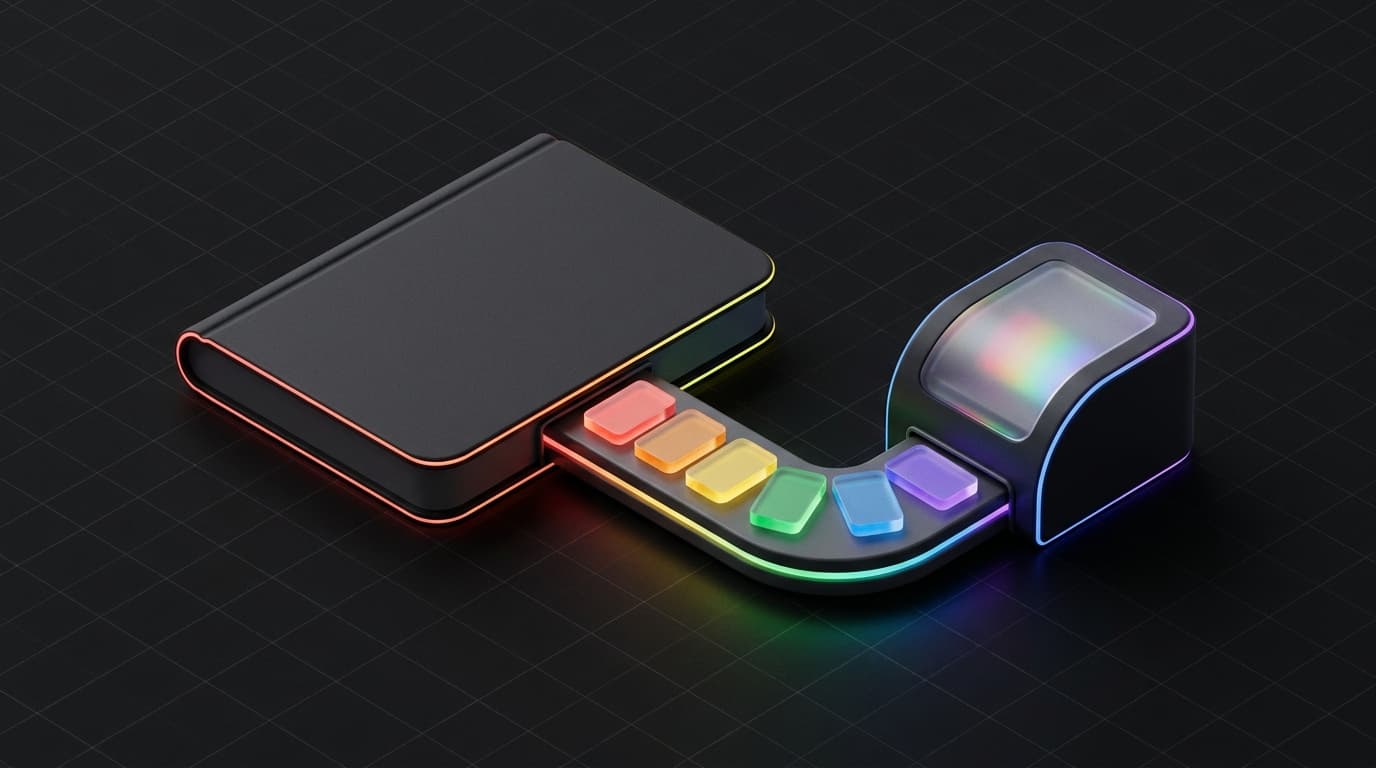
What does it mean that your brand identity becomes machine-readable?
Design tokens turn your brand identity into a file that software can execute. Colours, spacing, font sizes and corner radii sit in it as separate named values, not as images and descriptions in a PDF. Since 28 October 2025 there has been one stable specification for this. That day the Design Tokens Community Group published version 2025.10 with the status stable, after four years of drafts. Figma switched on native import and export the same day.
For you as a brand owner that means one thing. From now on your brand identity exists twice. There is the document that convinces people, and there is the file that machines execute. The second copy decides what actually ends up on screen: in the online store, in the newsletter, in the app, in the template someone in marketing uses to make a banner. And at almost every brand, nobody has ever opened that second copy.
Over the past few weeks we checked this source by source, instead of trusting the summaries. Three things came out of it that change the conversation with your designer or developer. The spec is stable, but it is still being patched. The largest design tool in the world has shipped the feature, so the debate about whether this will happen is over. And "supports design tokens" on a vendor page proves nothing, because that claim has already been shown to be untrue at least once.
Below is what is settled, what is still moving, and what you can check yourself without calling a developer.
What has been settled since 28 October 2025, and what is still moving
The specification has three parts, and that matters more than it sounds. The Format module describes what a token looks like. In the Color module you find how a colour is written down: not as a hex code, but as an object with a colour space and separate components. Finally, the Resolver module governs how the same tokens behave in several contexts, such as a light and a dark mode. That third part is what lets one brand identity serve several variants without a second palette creeping in.
The status history is public on the working group's site:
| Version | Status | Published |
|---|---|---|
| 2025.10 | stable | 28 October 2025 |
| third editors' draft | draft | 21 July 2025 |
| second editors' draft | draft | 14 June 2022 |
| first editors' draft | draft | 23 September 2021 |
Now read the small print. The specification itself says: "It is not a W3C Standard nor is it on the W3C Standards Track." This is a community specification, not an official standard. And stable is not the same as finished. On 20 September 2026 the working group's public issue list held 91 open issues and proposals, with changes running into September 2026.
There is also a trap your developer can walk straight into. Next to the stable text there is a working version online, and it carries this warning at the top: "Do not attempt to implement this version of the specification." That is word for word what the preview version of the Format module says. Two addresses, almost the same text, and only one of them is meant to be built on. So do not ask whether someone follows the specification. Ask which version, and have the version number written into the deliverables.
Why did Figma wait four years to support design tokens natively?
That the spec is now stable is not academic news, because the largest design tool in the world tied its roadmap to it. At its own conference on 28 October 2025, Figma put it in plain words: "We've held off on adding this feature, opting instead to release an open source import/export plugin, until The Design Tokens W3C Community Group (DTCG) finished their 1.0 release." And then: "The community group spec is now officially at 1.0, along with native import and export support in Figma."
For four years the polite reason to do nothing was that there was no spec yet. That reason expired in a single day. That is the real news for brand owners: you no longer have to convince anyone that a brand identity should be exportable. It sits in the tool your designer already has open, as a button.
What that changes in a project with us is small but noticeable. Until last year we delivered a brand identity as a set of files plus a document, and then the developer started retyping everything by hand. Colours from a PDF into a stylesheet, spacing from a sketch into a scale, and every round of retyping lets a deviation slip in. Not one big mistake, but a colour two shades off the original and a margin of 18 instead of 16 pixels. Six months later the site no longer matches the brand and nobody can point to where it happened.
A tokens file removes the retyping step, and that is the entire benefit. It makes no promise about revenue and brings no new kind of creativity. It gives you one source that nobody has to copy by hand. That is why it is a standard part of our brand identity and brandbook projects, next to the document that explains the choices.
Why "supports design tokens" on a vendor page says nothing
This is the finding that makes the article worth reading. On 4 May 2026 an integrator ran the export of a design tool, looked at what came out and compared it with the specification. It did not match. The tool did not write a file in the new spec format, but in the format of an older plugin. The public report in that tool's community quotes the tool's own documentation: "Penpot natively supports the design tokens standard", in other words the exchange format of the Design Tokens Community Group. Underneath is what actually came out of the button.
The differences are not cosmetic:
| Element | The 2025.10 spec | What the export produced |
|---|---|---|
| Structure | one flat file of tokens | several sets inside a wrapper |
| Extra keys | has no $themes or $metadata |
$themes, $metadata, tokenSetOrder |
| Colour | object with colour space and components | hex string |
| Sizes | value and unit kept separate | one string such as 16px |
The report puts it drily: the spec has no sets, themes, tokenSetOrder or activeThemes. That is not a detail for engineers. It means the file you think of as your brand identity cannot be opened in the next tool without conversion work. And you only find out when someone other than its maker tries to use it, usually a year later, usually under time pressure.
The lesson is not that this one tool is bad. The lesson is that the sentence "supports design tokens" on a product page is not a verifiable statement. There is no version number next to it, no test result, and nobody checks it. Ask every vendor who makes this claim for an export file and look inside it. That is half an hour of work and it is the only proof that counts. We apply the same reflex to figures in trade articles. Our piece on brand statistics that said something else once we checked the source explains why.
The reason behind a colour sits in a field a tool may drop
A token is a name and a value, and it does not need to be more than that. The specification also allows an explanation. In the Format module it reads: "A plain text description explaining the token's purpose can be provided via the optional $description property." Note that word: optional. The explanation may be included, but it does not have to be.
That looks like a footnote, but it is the core of your brand work. The value of a colour is a technical detail. Why that colour was chosen, where it may and may not appear, and which colour must never touch it: that is brand content. It is the part we spend weeks on and the part the client pays for. And it sits in the only field in the file that a tool may skip without consequence.
So every handover has a leak. The file reaches the developer, the values are correct, and the reason has evaporated along the way. The developer sees a list of colours with no ranking and picks whichever colour suits him best. That is not carelessness on his part. He simply never got an instruction.
That is where we come in, and the work is concrete. We deliver the explanation layer that the tool does not carry: a reason for each token, an explicit permission or ban for each colour pairing, and a scale that says which size belongs where. It is the same discipline we already apply to typography, which we wrote about in typography as a brand asset. A typeface without a usage rule gets used at random. So does a colour without a reason.
The practical rule of thumb: when you receive a tokens file, open it and look for the explanation. If it is not there, you have received a technical list, not a brand identity.
Which figure can you actually use to justify a brand identity?
This belongs in this article because the next question always comes: what does it deliver? The market has given the same percentage for years, and that percentage does not hold up.
Almost every agency sells a brand identity on the promise that consistent branding raises revenue. The source is a 2016 study by the vendor now called Marq. The chain can be traced. A press release from December 2019 reports that consistent branding can raise revenue by 33% and calls that "a 10% increase over the 2016 report", based on a sample of "over 200 organizations".
The same vendor's own page now carries the sentence that matters: "Companies estimate that consistently maintaining their brand could drive a 10-20% increase in overall growth and revenue."
Estimate. Revenue was never measured. Marketers were asked what they thought would happen, and that answer was then quoted for years as if it were a measurement. The number has also changed from edition to edition, while the market keeps citing the highest version.
There is one figure that rests on behaviour rather than on an estimate. A brand platform analysed its own usage logs across more than 10,000 brands, not a survey. The result: the average number of publications per template is 32.5, and template use grew by 42% in a year. That measures reuse, not revenue. And that is exactly why it is usable.
| Claim | What was actually done | Usable as |
|---|---|---|
| Consistent branding raises revenue | marketers asked about an expectation | nothing |
| 33% compared with the 2016 report | the same question, a different edition | nothing |
| 32.5 publications per template | usage measured inside the platform itself | argument for reuse |
This is how you justify a brand identity honestly: not with a revenue promise, but with production time and repeatability. A tokens file strengthens exactly that argument, because it is the form in which reuse happens automatically.
Can AI agents read your brand identity directly?
Alongside the file there are two more tracks, and both pull the brand identity out of the document.
The first track is the brand identity as a source that agents can query. Figma provides a server that lets coding agents look straight into a design file. The official list of available tools includes two that matter for brands: get_variable_defs, described as "variables and styles used in a selection", and search_design_system, described as "searches libraries for components, variables, styles". An agent that writes code no longer has to guess your brand colour. It can look it up. What it retrieves is what you have recorded, including the mess you left in place.
The second track is the brand identity as part of a model. On 28 October 2025 Adobe announced Firefly Foundry: models trained on a brand's own catalogue, covering image, video, audio, vector and 3D, delivered through Adobe's own applications. The announcement names Walt Disney Imagineering as a partner. Whether that becomes relevant for your brand depends on how much imagery you produce, but the direction is clear: brand knowledge is moving from a document into a system.
Put those two next to the tokens file and your brand identity has three forms. A document for people, a file for tools, and a source that agents can query. Whoever decides what goes into the second and third form decides how your brand will look in places where no designer is watching any more. That is why, for us, technology and AI sit next to design in what we deliver, and not as a separate package.
The token audit: what you can check yourself this week
You can do this without hiring anyone, and it takes about an hour.
Step 1: ask for the export. Ask your designer for an export of the variables from the design file. Not a screenshot of the palette, the file itself. If you do not get it, that is your first answer: your brand identity does not yet exist anywhere in a form a machine can read.
Step 2: open it and look at the shape. If there are keys starting with $themes, $metadata or tokenSetOrder, it is not the format of the stable spec but that of a plugin. That can work fine in your own toolchain, but do not call it portable.
Step 3: look for the explanation. Search for $description. If you find nothing, the reason behind every choice got lost along the way. That can be repaired, and it is manual work.
Step 4: count the colours. More than twenty unique colour values in a brand that claims to have three colours means the palette has already sprawled in practice. Tokens expose that mercilessly, because every deviation gets its own line.
Step 5: record the version number. Put in the handover terms which version of the specification you are delivering against. Without a version number, "we deliver design tokens" is no more verifiable than "we support design tokens".
What you have after that hour is not a technical report but a list of gaps. In our work it is invariably the same list: too many colours, no explanation, and an export nobody ever opened. For online stores that also have a checkout and a template system hanging off this, the broader approach is described under websites.
How we hand over a brand identity now that the spec is stable
We changed our own handover this year, and not because it sounds good in a proposal. It saves arguments afterwards.
We hand over every brand identity in two layers. The first layer is the document: positioning, logic, what is and is not allowed, with examples. That stays, because people do not make decisions based on a JSON file. The second layer is the file with the values, with the version number attached and with the explanation for each token filled in, in the field meant for it. Leave the explanation empty and you have delivered half the job.
It fits a habit you will see throughout our work: we check the source ourselves before we use it. For this article that meant checking every claim at its source. Two points from the summaries doing the rounds did not hold up when we checked, so they are not in here. We use the same approach for our own systems, which we have been open about in what an agent system costs to maintain. Measure, write it down, even when the answer is disappointing.
For existing clients the conversion is usually small. The palette is fixed, the type scale is fixed, and then it is a matter of making one file and including it in the handover. For brands whose colours have started to drift from channel to channel, the first step is a clean-up. That clean-up is the actual brand work, and it is the reason a brandbook is more than a nice PDF. If you want to know what that looks like for your brand, we will look at your existing export in a half-hour call and tell you what is in it now. You can reach us via contact.
Three things to take with you
Not a summary, but the three sentences that will get you a better conversation with your designer or agency tomorrow.
Ask for the version number. "We deliver design tokens" is not a commitment. "We deliver tokens according to version 2025.10, and here is the export file" is.
Open the export. Looking inside the file yourself once tells you more than any vendor page. What you are looking for: the structure, and the field with the explanation.
Do not buy a brand identity on a revenue promise. The percentage doing the rounds comes from a question about expectations, not from a measurement. What you can expect is less retyping, fewer deviations and faster production. That is enough, and it is true.
Frequently asked questions
What exactly are design tokens? Design tokens are the individual, named values of your brand identity in a file that software can read: colours, spacing, font sizes, corner radii. Instead of a picture of your palette, a developer gets a list with an exact value for each name. The specification for that file has been marked stable since 28 October 2025.
Do I need design tokens if I only have a website? If your brand identity lives in one place and stays there, it gives you little. It pays off once the same values have to be right in several places: site, online store, newsletter, app, ad templates.
My design tool says it supports design tokens. Is that enough? Not until you open the export. In May 2026 an export button turned out to produce a different format from the one the tool's own documentation claimed. Export, open the file, check the structure.
What does it cost to convert an existing brand identity into tokens? That depends on the state of the brand identity, not on the technology. We convert a fixed palette and a clear scale in days. If the colours drift from channel to channel, a clean-up comes first, and that is the real work.
Does a tokens file replace my brandbook? No. The brandbook convinces people, the file executes. The specification does have a field for explanation, but it is optional and may disappear on export. That is why the document stays.
