
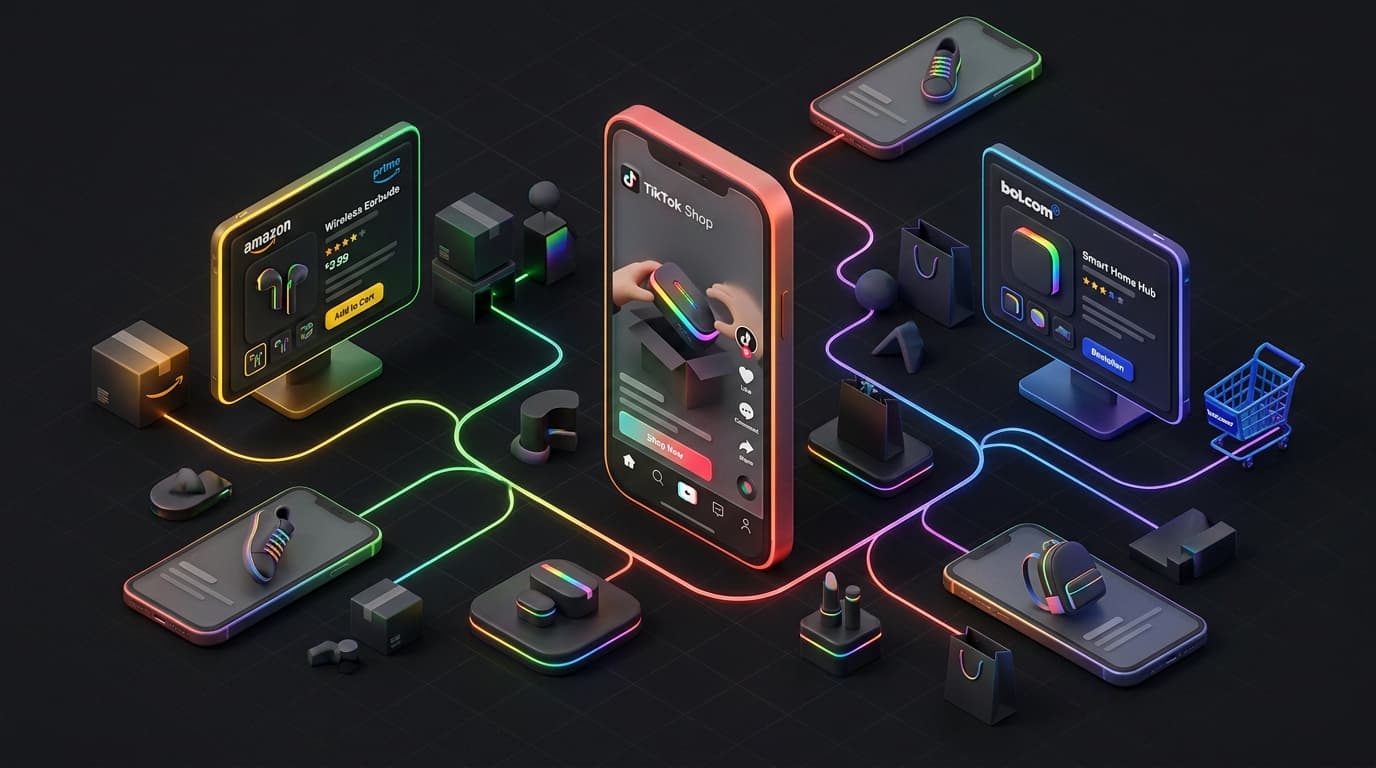
TikTok Shop is running in the Netherlands. The question is no longer whether you join.
TikTok Shop went live in the Netherlands on 15 June 2026, together with Belgium, Poland, and Austria. Sellers could sign up from 1 June. The channel opened with a reach of 7.5 million monthly users in the Netherlands.
That was eleven weeks ago. So the discussion is no longer whether this channel is coming, but what its first months reveal. And that is sharper than the launch coverage suggested.
The core: TikTok Shop rewards rhythm and recognition, and it punishes thinly positioned products harder than a marketplace does. On bol you can be invisible and still sell, because somebody searched for your product type. Here nobody is searching for you. You have to stop someone mid-scroll, and that only works if there is something to recognise.
What the first weeks in the Netherlands showed
The analysis of the first six weeks of TikTok Shop in the Netherlands produced three numbers you need to know commercially before you start. They belong together.
| What | Figure | What it means for you |
|---|---|---|
| Reach at launch | 7.5 million monthly users in the Netherlands | Not a niche channel, but one where you produce all of your own visibility |
| Livestream rhythm for growth | 3 to 5 per week as the floor, daily gives the clearest effect | This is a production process, not a campaign you run once |
| Tipping point to profit | From roughly 35 percent product margin, at 9 percent platform commission and 10 to 30 percent creator fees | Below that margin you are selling revenue, not profit |
That last figure is the most important and the least discussed. Nine percent commission is not the problem. The creator fee is: it runs up to thirty percent, and it is precisely the line item you do not negotiate down when the creator does not need your brand to make their video work.
That is the branding question, expressed in money. A creator promoting a generic product is selling their own reach and charges full price for it. A creator showing a brand that viewers recognise is selling alongside something you built. That difference does not sit in the video. It sits in what there is to recognise before the video starts.
Why brand identity weighs heavier on a video-first platform
On bol or Amazon you compete on product pages. You have images, a title, bullet points, and an A+ Content section to convince. The customer searches actively, compares, and chooses.
TikTok Shop works fundamentally differently. Products are discovered through videos and livestreams. There is no search-bar intent. The buyer is not in comparison mode. You have a few seconds to stop someone, hold them, and convince them.
That does not work with a generic product. It works with a recognisable brand.
| Factor | Static marketplace | TikTok Shop |
|---|---|---|
| First impression | Product photo on a white background | Video content in the feed |
| Purchase decision | Comparison with competitors | Impulse purchase based on trust |
| Brand recognition | Logo on the listing | Visual identity in image, motion, and sound |
| Returning customer | Repeat purchase via the search bar | Recognition in the feed through a consistent brand |
| Cost structure | Commission and advertising | Commission, creator fees, and production time |
Brands that already have a strong visual identity perform better on every new channel from day one. What we see in practice: a brand that feels the same everywhere has to rebuild less trust per channel.
On TikTok Shop that effect is stronger than elsewhere. Because you are not only fighting competitors. You are fighting the scroll.
What changed on 1 July
There is a second shift that touches the TikTok story, and it favours Dutch brands.
Since 1 July 2026 a customs duty of 3 euros applies to parcels from outside the EU with a value below 150 euros. The charge applies per product or product group in a shipment and runs until 1 July 2028, when the EU customs data centre for e-commerce becomes operational.
For a Dutch brand holding local stock, that is a structural cost advantage at the cheapest end of the market. But a cost advantage is not a position. If your only argument is that you are now slightly less expensive than a parcel from China, you lose the moment that calculation changes. The advantage is that you now have room to compete on something other than price. What you do with that room is the question.
We wrote a separate piece about it, because it is the reflex we meet most often with new clients: cheap is not enough.
What else is changing for Dutch e-commerce brands
The E-commerce Monitor 2026 by Thuiswinkel.org shows a clear shift. A survey of 525 Dutch webshops found:
| What the Monitor measures | Result |
|---|---|
| Investing more in branding, service, and customer experience in response to international competition | 66% of webshops |
| Prioritising repeat purchases as the primary growth strategy | 57%, up 10 percentage points on the year before |
| Reporting strong revenue growth | Down from 19% to 12% |
| Reporting declining revenue | Up from 17% to 21% |
The message is clear: the era of growth by default is over. Brands that grow do so by investing in recognition and customer relationships, not by advertising more.
TikTok Shop accelerates that trend. Another channel where you have to be visible. Another place where your brand has to hold together. Another moment where the customer decides in a fraction of a second whether you are trustworthy.
How do you get your brand ready for this channel?
1. Test your visual identity for video use
Pull up your current brand guidelines and ask three questions. Does your logo work on a 60 by 60 pixel thumbnail? Is your colour palette recognisable in motion, on a phone, in poor light? Do you have a fixed form, or does every channel look different?
If your brand guidelines are not documented, your brand does not exist outside your own head. And a creator cannot apply it either.
2. Design for repetition, not for one video
Three to five livestreams a week means you need fixed elements you do not reinvent every time. A recognisable setup, consistent colours in the first frames, consistent overlays, a presenting style that fits your brand. That is not a luxury. It is the difference between a rhythm you can sustain and one that collapses after three weeks.
Product photography alone is no longer enough once you take video content seriously.
3. Do the margin maths before you approach a creator
Nine percent commission plus ten to thirty percent creator fees is the sum. Know where your product sits relative to that 35 percent before you agree terms. A brand with a story negotiates differently than a supplier with a discount.
4. Build recognition outside the channel
The brands that perform best on a new platform are the brands the customer already knows. Recognition does half the work before the first video even starts. You build that in your webshop, on your marketplace listings, and in your packaging, and it pays off here.
What does this mean if you mostly sell on bol or Amazon?
You might think: I sell well on bol, TikTok Shop is not my problem.
That is only half right. The point is not that you have to livestream tomorrow. The point is that the number of channels keeps growing, and only brands with a consistent identity survive that fragmentation without starting over each time.
On bol the requirements for product information keep shifting. On Amazon, A+ Content stops being a differentiator the moment everyone has it. On TikTok Shop, video is the norm. On Shopify, your webshop has to carry the brand story. The common thread: your brand has to feel the same everywhere, and that only works if the foundation is right.
In seven years we have delivered more than 200 projects for e-commerce brands at Oase Creative. From first listing to full brand book, from product photography to webshop. Where brands most often fail on marketplaces is exactly this point: they invest in advertising without a foundation. The brands that take their visual identity seriously have to work less hard on every new channel. The brand does the work.
What does Oase Creative do with TikTok Shop?
We track what happens on the channel and translate it into the work we are good at: a brand that holds up in motion. Not a livestream agency, but the party that makes sure there is something to recognise the moment you or a creator starts that livestream.
Want to know where your brand stands? Book a call and we will walk through your current brand identity together. No sales pitch. An honest read of where you are and what is needed.
